
Professor Douglas Kell, chief executive of the Biotechnology and Biological Sciences Research Council (BBSRC), is calling for an additional £100m a year to be spent on food research in the UK to help the world meet growing demand.
...
He told the BBC Radio 4 Today programme: "We have seen already in Indonesia and Mexico riots because of food shortages and what is undeniable is that the amount of food we are going to need to produce to deal with the world's population increases is an extra 50 per cent by 2030 and a doubling by 2050.
"We are going to have to do it on the same amount of land, because there isn't any more land, so we are going to have to increase agricultural yields.
"We are going to have to do that without increasing the amount of oil-based fertilisers we put in because oil is a finite resource and of course produces greenhouse gases.
"And we are going to have to use no more water because water is a resource in short supply as well."
He added: "Scientific research takes a long time to turn into applied fruits that are going to be of benefit to humanity and that is why we need to start the ball rolling now."
Thursday, April 30, 2009
Staving Off Food Riots Could be a Tall Order Indeed
from the Independent:


WHO Raises Pandemic Alert Level to 5
from CNN:
Most people I know are cautiously worried about this thing, but see it as a simple matter of whether or not they themselves will get sick or not. People on the whole are missing the larger impact that a pandemic flu scare could have on an already reeling world economy.
If people opt (or are asked to) stay home from restaurants and public events (as is happening in Mexico city), the impact on the economy could be sudden and severe.
"This change to a higher phase of alert is a signal to governments, to ministries of health and other ministries, to the pharm industry and the business community that certain actions now should be taken with increased urgency and at an accelerated pace," Chan said.
Most people I know are cautiously worried about this thing, but see it as a simple matter of whether or not they themselves will get sick or not. People on the whole are missing the larger impact that a pandemic flu scare could have on an already reeling world economy.
If people opt (or are asked to) stay home from restaurants and public events (as is happening in Mexico city), the impact on the economy could be sudden and severe.
Sunday, April 26, 2009
CDC Issues US National Health Emergency for Swine Flu
from NPR:
U.S. health officials declared a public health emergency Sunday in response to a growing outbreak of swine flu, as Canada reported its first confirmed cases.
At a White House briefing, Homeland Security Secretary Janet Napolitano said the declaration "sounds more severe than it really is," but said it authorizes public health officials to put an apparatus in place for additional testing, to distribute antiviral medications and to take other steps if needed.
Napolitano said roughly 12 million doses of antiviral drugs will be moved from a federal stockpile to places where states can quickly get their share if they decide they need it. Priority will be given to the five states with known cases so far: California, Texas, New York, Ohio and Kansas.
Swine Flu Erupts in Mexico, Threatens Pandemic

from the BBC:
The Mexican government, which has faced criticism for what some see as a slow reaction to this outbreak, is now taking an increasingly hard line to try to contain the virus, says the BBC's Stephen Gibbs in Mexico City.
Public buildings have been closed and hundreds of public events suspended.
Schools in and around Mexico City have been closed until 6 May, and some 70% of bars and restaurants in the capital have been temporarily closed.
People are being strongly urged to avoid shaking hands, and the US embassy has advised visitors to the country to keep at least six feet (1.8m) from other people.
Mexico's Health Secretary, Jose Cordova, said a total of 1,324 people had been admitted to hospital with suspected symptoms since 13 April and were being tested for the virus.
"In that same period, 81 deaths were recorded probably linked to the virus but only in 20 cases we have the laboratory tests to confirm it," he said.
Mexico's President Felipe Calderon has announced emergency measures to deal with the situation.
They include powers to isolate individuals suspected of having the virus without fear of legal repercussions.
When it rains, it pours.
Thursday, April 23, 2009
Current Optimism is Misplaced
via the Economist:
It is easy to read too much into the gain in share prices. Stockmarkets usually rally before economies improve, because investors spy the promise of fatter profits before the statisticians document a turnaround. But plenty of rallies fizzle into nothing. Between 1929 and 1932, the Dow Jones Industrial Average soared by more than 20% four times, only to fall back below its previous lows. Today’s crisis has seen five separate rallies in which share prices rose more than 10% only to subside again.
The economic statistics are hard to interpret, too. The past six months have seen several slumps, each with a different trajectory. The plunge in manufacturing is in part the result of a huge global inventory adjustment. With unsold goods piling up and finance hard to come by, firms around the world have slashed production even faster than demand has fallen. Once firms have run down their stocks they will start making things again and the manufacturing recession will be past its worst.
Even if that moment is at hand, two other slumps are likely to poison the economy for much longer. The most important is the banking crisis and the purge of debt in the bubble economies, especially America and Britain. Demand has plummeted as tighter credit and sinking asset prices have exposed consumers’ excessive borrowing and scared them into saving more. History suggests that such balance-sheet recessions are long and that the recoveries which eventually follow them are feeble.
The second slump is in the emerging world, where many economies have been hit by the sudden fall in private cross-border capital flows. Emerging economies, which imported capital worth 5% of their GDP in 2007, now face a world where cautious investors keep their money at home. According to the IMF, banks, firms and governments in the emerging world have some $1.8 trillion-worth of borrowing to roll over this year, much of that in central and eastern Europe. Even if emerging markets escape a full-blown debt crisis, investors’ confidence is unlikely to recover for years.
These crises sent the world economy into a decline that, on several measures, has been steeper than the onset of the Depression. The IMF’s latest World Economic Outlook expects global output to shrink by 1.3% this year, its first fall in 60 years. But the collapse has been countered by the most ambitious policy response in history. Central banks have pumped out trillions of dollars of liquidity and, in rising numbers, have resorted to an increasingly exotic arsenal of “unconventional” firepower to ease credit markets and loosen monetary conditions even as policy rates approach zero. Governments have battled to prop up their banks, committing trillions of dollars in the process. The IMF has new money. Every big rich country has bolstered demand with fiscal stimulus (and so have many emerging ones). The rich world’s budget deficits will, on average, reach almost 9% of GDP, six times higher than before the crisis hit.
The Depression showed how damaging it can be if governments don’t step in when the rest of the economy seizes up. Yet action on the current scale has never been tried before and nobody knows when it will have an effect—let alone how much difference it will make. Whatever the impact, it would be a mistake to confuse the twitches of an economy on life-support with a lasting recovery. A real recovery depends on government demand being supplanted by sustainable sources of private spending. And here the news is almost uniformly grim.
Food Shortages Could Spell Societal Collapse
from Scientific American:
The entire article is dense, focused, and compelling. Highly recommended reading, especially as a persuasive piece to send to anyone who might need a wake-up call.
For most of us, the idea that civilization itself could disintegrate probably seems preposterous. Who would not find it hard to think seriously about such a complete departure from what we expect of ordinary life? What evidence could make us heed a warning so dire—and how would we go about responding to it? We are so inured to a long list of highly unlikely catastrophes that we are virtually programmed to dismiss them all with a wave of the hand: Sure, our civilization might devolve into chaos—and Earth might collide with an asteroid, too!
For many years I have studied global agricultural, population, environmental and economic trends and their interactions. The combined effects of those trends and the political tensions they generate point to the breakdown of governments and societies. Yet I, too, have resisted the idea that food shortages could bring down not only individual governments but also our global civilization.
I can no longer ignore that risk. Our continuing failure to deal with the environmental declines that are undermining the world food economy—most important, falling water tables, eroding soils and rising temperatures—forces me to conclude that such a collapse is possible.
The entire article is dense, focused, and compelling. Highly recommended reading, especially as a persuasive piece to send to anyone who might need a wake-up call.
Transition Movement spreading in US...
The NYT has an interesting article on one small town's quasi-embrace of the Transition movement.
It's a long article that's worth reading for a variety of reasons, not the least of which is the matter-of-fact way with which it's written, somewhatsurprising given that it's for the New York Times and is essentially about preparing for the end of the modern world. At several points, the author lets on to the idea that some of these ideas seem far less crazy today than they would have in times recently past. It doesn't read (at least not to me) like an outsider's view of a fringe, cultish group.... and it easily could.
Slightly distressing was the deep and distracting "feel good hippie culture" undertone that immediately became a vocal force within the Transition group discussed in the article. Holding hands and "sending your energy counter-clockwise in a circle" probably seems like an appropriate starting point if you've gummed up your mind with 40 years of THC and elf worship, but (as several other interviewees in the article point out), it's not going to do a damned thing to actually get anything done.
Given the choice, I'd rather form a community with a group of capable people that I can absolutely trust with my life. Because after the "vibes" settle, that's what we're talking about here. Speaking of which, a big hat tip to Jess for the link!
It's a long article that's worth reading for a variety of reasons, not the least of which is the matter-of-fact way with which it's written, somewhatsurprising given that it's for the New York Times and is essentially about preparing for the end of the modern world. At several points, the author lets on to the idea that some of these ideas seem far less crazy today than they would have in times recently past. It doesn't read (at least not to me) like an outsider's view of a fringe, cultish group.... and it easily could.
Slightly distressing was the deep and distracting "feel good hippie culture" undertone that immediately became a vocal force within the Transition group discussed in the article. Holding hands and "sending your energy counter-clockwise in a circle" probably seems like an appropriate starting point if you've gummed up your mind with 40 years of THC and elf worship, but (as several other interviewees in the article point out), it's not going to do a damned thing to actually get anything done.
Given the choice, I'd rather form a community with a group of capable people that I can absolutely trust with my life. Because after the "vibes" settle, that's what we're talking about here. Speaking of which, a big hat tip to Jess for the link!
Wednesday, April 22, 2009
Taliban Seize Town in Pakistan
from the NYT:
Yikes.
Taliban militants have established control of a strategically important area only 70 miles from the capital, law enforcement officials said Wednesday. The move is part of an unrelenting push by the Taliban toward the heart of Pakistan.
Heavily armed militants were patrolling villages and local police had retreated to their station houses in much of the city of Buner, a rural area adjacent to Swat, where the Taliban seized control from the Pakistani army in February, they said. Buner is a gateway to a major Pakistani city, Mardan.
“They take over Buner, then they roll into Mardan and that’s the end of the game,” a senior law enforcement official in the North West Frontier Province said.
Yikes.
Banks Struggle to Keep Pace with Bad Loans
from CNN Money:
While BofA has doubled its loan loss reserve, nonperforming assets -- loans that are no longer producing income as borrowers fall behind on payments -- have more than tripled, reflecting the weakening economy and the acquisition of troubled Countrywide and Merrill Lynch.
As a result, BofA's loan loss reserve now covers just 121% of its nonperforming loans -- down from 203% a year ago.
That means the bank has a thinning cushion just as the industry braces for rising losses on commercial and industrial loans, as well as continuing declines in residential real estate.
Another bank with a thin cushion is Citi, which reported an unexpected $1.6 billion first-quarter profit Friday even as credit costs doubled from a year ago.
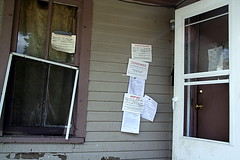
Un-marketed Foreclosures Could Spell Future Disaster
from the SF Gate:
"We believe there are in the neighborhood of 600,000 properties nationwide that banks have repossessed but not put on the market," said Rick Sharga, vice president of RealtyTrac, which compiles nationwide statistics on foreclosures. "California probably represents 80,000 of those homes. It could be disastrous if the banks suddenly flooded the market with those distressed properties. You'd have further depreciation and carnage."
In a recent study, RealtyTrac compared its database of bank-repossessed homes to MLS listings of for-sale homes in four states, including California. It found a significant disparity - only 30 percent of the foreclosures were listed for sale in the Multiple Listing Service. The remainder is known in the industry as "shadow inventory."
"There is a real danger that there is much more (foreclosure) inventory than we are measuring," said Celia Chen, director of housing economics at Moody's Economy.com in Pennsylvania. "Eventually those homes will have to be dealt with. If they're all put on the market, that will add more inventory to an already bloated market and drive down home prices even more."
What To Do If You Are Laid Off
The Wall Street Journal has a point-by-point guide that details your best course of action, should you get canned.
Green Needs Green
Great piece in Slate which details the extent to which Green technology is inherently tied to investement.
...the future of the alternative-energy industry now depends far more on financial engineering than mechanical engineering. Clean-tech trade publications are filled with breathless coverage of new innovations: thin-film solar technology, advanced batteries, cars powered by hydrogen fuel cells. But money has never been harder to come by, thanks to the struggling capital markets. "The alternative-energy sector is flat on its back," says David Crane, CEO of giant energy producer NRG. "There's no debt financing available from Wall Street." The Cleantech Group reported that in the first quarter of 2009, total green-energy-venture investments fell 50 percent from the first quarter of last year.
Niall Ferguson: "Globalization Could Unravel"

There's a very interesting (if misleadingly subtitled) article over at the Globe and Mail where Harvard author Niall Ferguson makes some predictions about the resolution of the financial crisis, and globalization. The interview as a whole is very much worth reading, but I'll post some highlights here:
Will globalization survive this crisis?
It's a question that's well worth asking. Because when you look at the way trade has collapsed in the world in the last quarter of 2008 – countries like Taiwan saw their exports fall 45 per cent – that is a depression-style contraction, and we're in quite early stages of the game at this point. This is before the shock has really played out politically. Before protectionist slogans have really established themselves in the public debate. Buy America is the beginning of something I think we'll see a lot more of. So I think there's a real danger that globalization could unravel.
Part of the point I've been making for years is that it's a fragile system. It broke down once before. The last time we globalized the world economy this way, pre-1914, it only took a war to cause the whole thing to come crashing down. Now we're showing that we can do it without a war. You can cause globalization to disintegrate just by inflating a housing bubble, bursting it, and watching the financial chain reaction unfold.”
....
You speak about the crisis being in its early days, but most policy makers and the International Monetary Fund are predicting a quick end to it. Where do you differ with them?
“I do think they're wrong. I think the IMF has been consistently wrong in its projections year after year. Most projections are wrong, because they're based on models that don't really correspond to the real world. If anything good comes of crisis, I hope it will be to discredit these ridiculous models that people rely on, and a return to something more like a historical understanding about the way the world works.”
“I mean most of these models, including, I'm told, the one that policy makers here use, don't really have enough data to be illuminating … You're going to end up assuming that this recession is going to end up like other recessions, and the other recessions didn't last that long, so this one won't last so long. But of course this isn't a recession. This is something really quite different in character from anything we've experienced in the postwar era. That's why these projections give positive numbers for 2010. That's the default setting. And it just seems to me ostrich-like, to bury one's head in the sand and assume this has to end this year because, well, that's what recessions do.
“It's obvious, surely we know by now, that this is something quite different. It's a crisis of excessive debt, the deleveraging process has barely begun, the U.S. consumers are not going to suddenly bounce back and hit the shopping malls just because they get a tax cut. The savings rate is going to continue to rise. These processes have tremendous momentum that quite clearly differentiates them from anything that we've seen, including the early 80s, including 73, 74, 75. Those big crises, the ones that we have lived through, were bad. But seems certain to be deeper, and more protracted.”
...
"I've been talking a while about this being the Great Repression. It took ages, ages, for people to realize this thing had fallen apart."
“August, 2007, was when this crisis began. And if you were really watching the markets carefully, April is when it began, when the various hedge funds started to hemorrhage. The stock markets carried on until October of that year. And in many ways, consumer behaviour in the U.S. did not change until the third quarter of 2008. So there was a massive denial problem. It was like Wile E. Coyote running off a cliff, and they'd run off a cliff and they didn't look down so they didn't start falling. As soon as people realized it was bad, the behaviour switched. Now, people have to try to unscare them before this thing becomes a self-perpetuating downward spiral. I think that's why you have to say ‘growth will return in 2010' with your fingers crossed behind your back.”
As goes our tiny blog, so goes the New York Times.
I'm sure I'm not the first to call the bank earnings a hat trick, but I sure beat the NYT there...
I'm sure I'm not the first to call the bank earnings a hat trick, but I sure beat the NYT there...
Tuesday, April 21, 2009
Santa Cruz Faces Water Shortage

via KSBW.com:
With temperatures rising, Santa Cruz is on the verge of putting new water restrictions in place.
In fact, next week city leaders are expected to declare a stage two water shortage.
The restriction includes water use for odd number addresses using water on certain days and even number addresses using water on other days.
If put in place, the restrictions will not be voluntary and breaking the rules may mean facing a fine.
Santa Cruz draws its water from the San Lorenzo River. The water flow is low and even though February rains filled Loch Lomond Reservoir, it still isn't enough to meet the demand.
Ocean "Dead Zones" Likely to Grow Due to Climate Change
from the BBC:
Writing in the journal Science, researchers at the Monterey Bay Aquarium Research Institute say that ocean 'dead zones' are likely to grow with climate change.
As our oceans warm and absorb more carbon dioxide, CO2 overload and oxygen starvation could conspire to create deadly 'super-pockets' of acidic seawater that not only threaten marine life, but also generate nitrous oxide, a greenhouse gas, according to the research.
'Acid' seawater won't eat through four floors of the spaceship Nostromo with a single drip, but the study predicts that it will 'impose a physiological strain on marine animals, impairing performance' (performance here meaning the ability to feed, reproduce and convert carbon into shells, rather than, say, recite Mendelssohn's Violin Concerto in E minor.)
"Legacy" Asset bill to top $4T...
from CNN Money:
That's quite a legacy indeed...
The International Monetary Fund has raised its estimate of the amount of toxic assets that banks and financial institutions will have to dispose of or write down to $4 trillion.
The IMF released information from its latest "Global Financial Stability Report" (GFSR) Tuesday saying its estimates for global write-downs has increased from $2.7 trillion in January to $4 trillion partly as a result of including more types of assets that have been depreciating.
Previous estimates had only included U.S. originated assets. Also contributing to the new estimates is what the IMF calls "the worsening base-case scenario for economic growth," a projection that the recovery will be painful and slow.
Two-thirds of the $4 trillion in losses will likely fall on banks, although the IMF says that non-bank financial institutions like insurance companies and pension funds have also been hit hard by declines in asset prices on both equities and bonds.
"Shrinking economic activity has put further pressure on banks' balance sheets as asset values continue to degrade, threatening their capital adequacy and further discouraging fresh lending," according to the GSFR.
Cross border international lending has intensified the crisis in some emerging market countries, says the IMF, which expects net private capital flows to emerging market countries to be negative in 2009, while at the same time 2009 refinancing needs for the emerging markets are expected to be about $1.2 trillion.
"The global financial system remains under severe stress as the crisis broadens to include households, corporations, and the banking sectors in both advanced and emerging market countries," the IMF said.
That's quite a legacy indeed...

Monday, April 20, 2009
Goodbye Bland Affluence?
Peggy Noonan takes a stab at what lies ahead.
I wish I was talking to the people that she is... they're displaying a much greater sense of awareness than I hear around where I live. Maybe it's New York.
Well worth a read. She's managed to explain what is, I feel, the eventual silver lining of this whole situation, and the most we can hope for.
I wish I was talking to the people that she is... they're displaying a much greater sense of awareness than I hear around where I live. Maybe it's New York.
Well worth a read. She's managed to explain what is, I feel, the eventual silver lining of this whole situation, and the most we can hope for.
When Even Winning is Losing
Even investors desperate for good news aren't falling for the big banks' hat trick. For those of you playing along at home, this means that despite government intervention AND good earnings reports, investor and public confidence in the banks still sucks.
So the cheap window-dressings didn't work, now maybe can we try actually addressing the problems at hand?
So the cheap window-dressings didn't work, now maybe can we try actually addressing the problems at hand?
Jobless Rate Up in 46 States
Via the WSJ:
California and North Carolina in March posted their highest jobless rates in at least three decades, as unemployment increased in all but a handful of states during the month, the Labor Department said Friday.
California's unemployment rate jumped to 11.2% in March, while North Carolina rose to 10.8%, the highest for both since the U.S. government began a comprehensive tally of state joblessness in 1976.
The state-by-state employment figures showed only a few states avoiding the deterioration seen nationwide. Unemployment rose in 46 states during the month, and 12 states plus the District of Columbia posted unemployment rates in March that were significantly higher than the 8.5% nationwide figure the government released earlier this month.
The chief economist for California's finance department, Howard Roth, said the state's unemployment rate hasn't been this high since reaching 11.7% in January 1941. The highest level on record in California is 14.7% in October 1940, he said.
Commercial Real Estate Joins the Dogpile
from The Washington Post:
General Growth Properties, the giant shopping mall company whose holdings stretch from Tysons Corner to the planned community of Columbia and Baltimore's Inner Harbor, yesterday sought protection in bankruptcy court, citing debts of more than $27 billion.
The bankruptcy heralds a wave of trouble in commercial real estate that threatens to put another damper on the economy, industry analysts said. By the end of 2011, $1.2 trillion of commercial real estate debt will come due, and like General Growth, many of the borrowers will be unable to refinance or repay their loans, said Gregory H. Leisch, chief executive of Delta Associates, which tracks the industry.
That would spell more losses for banks and institutional investors such as life insurance companies that are already coping with the meltdown in residential real estate.
IMF Warns of Consequences, "Full Blown Slump," Despite Measures
quoted in full from The Telegraph:
Not to nitpick semantics, but how does a global recession get more severe and turn into "a full blown slump"? A full blown slump is what I do, in a chair, when I'm really tired. What is being discussed here is a global depression, no matter what silly name you paste on it.
This recession is likely to be "unusually long and severe, and the recovery sluggish," said the Fund, releasing two advance chapters from its World Economic Outlook. However, it warned there is a risk that it could spiral down into a full-blown slump unless further action is taken to stop "feedback effects" gathering force.
Dominique Strauss-Kahn, head of the IMF, said millions of people risk being pushed back into poverty as the economic storm ravages the most vulnerable countries. "The human consequences could be absolutely devastating. This is a truly global crisis, and nobody is escaping," he said.
"The free-fall in the global economy may be starting to abate, with a recovery emerging in 2010, but this depends crucially on the right policies being adopted today."
Mr Strauss-Kahn called for a urgent action to "cleanse banks" of toxic assets and for further fiscal stimulus beyond the 2pc of global GDP already agreed. The snag is that high-debt countries may have hit the limits already.
"The impact becomes negative for debt levels that exceed 60pc of GDP," said the Fund.
While no countries were named, this would raise questions about Japan, Germany, France, Italy and ultimately Britain and the US after their bank rescues.
The IMF said the US is at the epicentre of this crisis just as it was in the Depression, setting the two episodes apart from normal downturns. However, the risks are greater this time. "While the credit boom in the 1920s was largely spec ific to the US, the boom during 2004-2007 was global, with increased leverage and risk-taking in advanced economies and many emerging economies. Levels of integration are now much higher than during the inter-war period, so US financial shocks have a larger impact," it said.
The IMF said the global financial system is still under acute stress, with output tumbling and inflation falling towards zero in key nations. "The risks of debt deflation have increased," it said.
Abrupt halts in capital flows can have "dire consequences" for emerging economies, it said. Eastern Europe has already suffered the effects, with a 17.6pc fall in industrial production in February. The region is highly vulnerable to the credit crunch since it owes more than 50pc of its GDP to Western banks.
Synchronised world recessions striking all major regions are "historically rare" events, the Fund said. They last one and a half times as long typical downturns, and are followed by painfully slow recoveries.
Not to nitpick semantics, but how does a global recession get more severe and turn into "a full blown slump"? A full blown slump is what I do, in a chair, when I'm really tired. What is being discussed here is a global depression, no matter what silly name you paste on it.
This Weid Passivity...
from Jeffrey Goldberg's recent piece in The Atlantic:
We cannot collectively wrap our heads around the idea that things will not always be how they have been, and that the things we wanted so desperately to believe in may not come to pass as promised.
I’m not complaining, by the way, and not only because I have no right to complain. I make more money than most Americans. I will ungrudgingly pay more taxes if it means keeping people in their homes—even the schmucks in overleveraged McMansions. My wife and I are lucky. We have substantial equity in a small but perfectly nice house in Washington, D.C., a city that is now, among other things, America’s financial-services capital, which should help keep real-estate prices steady. I have a late-model minivan. Most important, I have a job (and in the thriving magazine industry, no less!). If I lose my job, then I’ll complain (at which point, of course, I’ll no longer have a public venue for my complaints). But for now, no whining: just confusion and bemusement and fear, along with an uncharacteristic sense of paralysis. In the past six months, I’ve bought and sold virtually no equities. And I rarely take the pulse of my 401(k).
I called a psychologist to find out what could explain this weird passivity. Daniel Kahneman is a Nobel Prize–winning innovator in the field of behavioral economics. He explained that my feelings of paralysis were to be expected.
“You no longer know the world you live in,” he said. “You played by the rules, the rules benefited you. The world functioned according to some regularities. Right now, it’s unclear what rules apply. There is a new regime. What seemed prudent earlier has disappeared. I’m surprised Americans aren’t more panicked. Americans seem to accept a level of insecurity in their lives that Europeans wouldn’t tolerate. Paralysis is one response to this level of insecurity.”
We cannot collectively wrap our heads around the idea that things will not always be how they have been, and that the things we wanted so desperately to believe in may not come to pass as promised.
Thursday, April 16, 2009
Prohibitive Cost Slows Nuclear Startups
from the Business Insider:
A new nuclear plant costs too much to compete with natural gas or coal. Opponents of the industry have successfully argued that nuclear is too mature a technology to receive new government incentives. Legislation aimed at building up alternatives to fossil fuels has largely left nuclear out in the cold. Some funds from the economic stimulus are also going to develop expensive and unproven technology to capture and store carbon emissions from coal-fired power plants.
Still, the nuclear rebirth is likely only delayed, not canceled. Federal funding is already available to build a handful of new reactors by the middle of the next decade. The Obama administration also aims to put a price on emissions, which would raise the cost of power from coal and gas relative to nuclear.
...The 26 proposed nuclear plants are for now an industry wish list. Nuclear plants are expensive - Progress Energy Inc. (PGN) recently estimated that two new reactors outside Tampa will cost $7 billion each. Duke Energy Corp. (DUK) plans to spend $1.8 billion to build a coal plant near Charlotte to produce nearly as much as one reactor.
Emissions Need to Be Reduced 70% to Avert Worst of Climate Change
from The Tech Herald:
Scientists at the National Centre for Atmospheric Research (NCAR) in Boulder, Colorado, have concluded that cuts in CO2 of at least 70 percent in this century are necessary to avert the dramatic consequences of a warming planet.
NCAR researchers have said that, if such a reduction in greenhouse gases were possible, symptoms such as the loss of Arctic ice, permafrost and large-level sea rise could be avoided.
"This research indicates that we can no longer avoid significant warming during this century," says NCAR scientist Warren Washington, lead author of the study. "But if the world were to implement this level of emission cuts, we could stabilise the threat of climate change and avoid catastrophe."
Research has shown that any additional global increase in temperature above around a single degree in Centigrade (1.8 degrees Fahrenheit) could prove to be a dangerous "tipping point" for the Earth's climate.
Using models from supercomputer studies, scientists at NCAR ran projected studies based on the assumption that carbon dioxide levels in the atmosphere could be held to levels of 450 ppm (parts per million) by the end of this century.
According to an NCAR statement: "The team's results showed that if carbon dioxide were held to 450 ppm, global temperatures would increase by 0.6 degrees C (about 1 degree F) above current readings by the end of the century."
"In contrast, the study showed that temperatures would rise by almost four times that amount, to 2.2 degrees C (4 degrees F) above current readings, if emissions were allowed to continue on their present course," the study concluded.
Today's news roundup...
It's the first truly lovely evening outside in a while and I want to go run around in it, so we're going with a simple linkdump of the day's news:
The second largest mall owner in America filed for bankruptcy.
Questions are being raised as to exactly how Goldman Sachs did so well this quarter.
Foreclosure filings jumped 24%, which might have more to do with unemployment than previously thought.
Speaking of unemployment, Slate has a great interactive tool to visually track job losses over time.
Simon Johnson has a great summary of the difference between the bank runs of yesteryear and today over on Freakonomics. It is precisely the new kind of run that almost brought the entire system to it's knees last September.
The second largest mall owner in America filed for bankruptcy.
Questions are being raised as to exactly how Goldman Sachs did so well this quarter.
Foreclosure filings jumped 24%, which might have more to do with unemployment than previously thought.
Speaking of unemployment, Slate has a great interactive tool to visually track job losses over time.
Simon Johnson has a great summary of the difference between the bank runs of yesteryear and today over on Freakonomics. It is precisely the new kind of run that almost brought the entire system to it's knees last September.
Wednesday, April 15, 2009
Alternative Energy vs Scalability

I am 100% all about using alternative energy to it's full beneficial potential. But I feel that such enthusiasm for the concept should not preclude hard, sometimes challenging facts about the nitty gritty and details. If we're going to do it, we need to do it right.
Robert Bryce has a great piece in the WSJ that brings some such facts to the forefront of the debate.
For the sake of convenience, let's convert the energy produced by U.S. wind and solar installations into oil equivalents.
The conversion of electricity into oil terms is straightforward: one barrel of oil contains the energy equivalent of 1.64 megawatt-hours of electricity. Thus, 45,493,000 megawatt-hours divided by 1.64 megawatt-hours per barrel of oil equals 27.7 million barrels of oil equivalent from solar and wind for all of 2008.
Now divide that 27.7 million barrels by 365 days and you find that solar and wind sources are providing the equivalent of 76,000 barrels of oil per day. America's total primary energy use is about 47.4 million barrels of oil equivalent per day.
Of that 47.4 million barrels of oil equivalent, oil itself has the biggest share -- we consume about 19 million barrels per day. Natural gas is the second-biggest contributor, supplying the equivalent of 11.9 million barrels of oil, while coal provides the equivalent of 11.5 million barrels of oil per day. The balance comes from nuclear power (about 3.8 million barrels per day), and hydropower (about 1.1 million barrels), with smaller contributions coming from wind, solar, geothermal, wood waste, and other sources.
Here's another way to consider the 76,000 barrels of oil equivalent per day that come from solar and wind: It's approximately equal to the raw energy output of one average-sized coal mine.
North Sea oil production drops...
From FT.com:
Yikes.
The remaining lifespan of the UK’s North Sea oil and gas production risks being halved as the economic crisis has prompted a plunge in exploration in one of the western world’s most important deposits, the industry has warned.
The number of exploration wells being drilled in the North Sea has collapsed by 78 per cent in the first quarter of 2009 compared with the same period last year, according to the most recent industry data from Deloitte, the accounting and consulting firm.
In total, only 18 exploration and appraisal wells were drilled in the UK during the first quarter, marking a 41 per cent drop in total drilling activity compared with the same period last year. UK Oil and Gas, the industry group, is even more pessimistic, forecasting that total drilling could drop 66 per cent this year.
Derek Henderson, senior partner at Deloitte, said: “Unless exploration is at a healthy clip, it risks shortening the life of fields and the overall UK continental shelf, in this case.”
Exploration and appraisal wells are critical to any oil region’s long-term supply prospects. But they are particularly important for the North Sea, where ageing fields’ production is rapidly declining.
The UK and Europe will increasingly have to rely on Russia for natural gas and the Middle East for oil.
The worsening exploration climate could knock 10-15 years off the North Sea’s expected lifespan of 20-30 years, meaning almost half of all its infrastructure could be decommissioned within the next 11 years, UK Oil and Gas estimates.
Instead of satisfying 45 per cent of the UK’s oil and gas needs in 2020, at the current investment pace the North Sea would only be able to meet 12 per cent of its demand.
Yikes.
All the jobs are Ore-gone?
Sorry, couldn't resist. In an apparent move to rival Michigan for "America's Least Employed State," Oregon's unemployment rate up and jumped almost 4 points in a single month, to 12.1%. The article doesn't say, but anybody want to take a guess if this is the U-3 or U-6 measure?
Life Insurance Companies face "Unprecedented Stress"
From Bloomberg:
North American insurers posted more than $190 billion of writedowns and unrealized losses tied to the collapse of the housing market since the beginning of 2007. The industry lost $32 billion in surplus last year, according to Moody’s Investors Service. This year, carriers including New York-based MetLife, Prudential and Hartford Financial Services Group Inc. have been buffeted by ratings downgrades.
MetLife’s unrealized losses on corporate debt surged 71 percent to $14 billion in the last three months of 2008 as the recession hurt firms’ ability to repay or refinance their bonds. Corporate defaults are poised for a “significant” increase this year and may end up costing life insurers more than losses on securities linked to subprime, Alt-A and commercial mortgages, according to Barclays Plc.
Who Tests the Stress Testers?
So it looks like we'll be hearing some concrete results about the stress tests in May.
That first sentence is a doozy. "We will be extra transparent in the way we show all of you part of the picture" is pretty much how I'm reading that. Why be selective? Why not be transparent and show everyone all of the results?
And it looks like the FDIC isn't a huge fan of the stress-tests either (perhaps knowing that they're the next line of defense should the results end up being a bit, shall we say, optimistic?), and Nouriel Roubini sounds like he has an answer for my ongoing question concerning the current state of the economy vs. the hypothetical scenarios put forward in the tests. From the RGE Monitor:
If that's true, then it points yet another finger at the idea that the administration still feels this crisis is one of "confidence" and not the hard numbers that so many are trying desperately to ignore and/or paper over.
"Early in May, you will see in a systematic and coordinated way the transparency of determining and showing to all involved some of the results of these stress tests," White House spokesman Robert Gibbs said.
The tests will assess how much of a "capital cushion" the banks are likely to need to stay healthy, given the current economic environment, he said.
"Our hope is that banks that are not healthy, or need help, will first and foremost seek that help privately, and then we'll take steps from there to assist them," Gibbs said.
That first sentence is a doozy. "We will be extra transparent in the way we show all of you part of the picture" is pretty much how I'm reading that. Why be selective? Why not be transparent and show everyone all of the results?
And it looks like the FDIC isn't a huge fan of the stress-tests either (perhaps knowing that they're the next line of defense should the results end up being a bit, shall we say, optimistic?), and Nouriel Roubini sounds like he has an answer for my ongoing question concerning the current state of the economy vs. the hypothetical scenarios put forward in the tests. From the RGE Monitor:
The FDIC and Treasury used assumptions for the macro variables in 2009 and 2010 both the baseline and more adverse scenarios that are so optimistic that actual data for 2009 are already worse than the adverse scenario. And for some crucial variables such as the unemployment rate – that is key to proper estimates of default rates and recovery rates (given default) for residential mortgages, commercial mortgages, credit cards, auto loans, student loans and other banks loans – current trend show that by the end of 2009 the unemployment rate will be higher than the average unemployment rate assumed in the more adverse scenario for 2010, not for 2009! In other terms, the results of the stress test – even before they are published – are not worth the paper they are written on as they make assumptions on the economy that are much more optimistic –even in the worst scenarios that the FDIC has designed - than the actual figures for Q1 of 2009.
If that's true, then it points yet another finger at the idea that the administration still feels this crisis is one of "confidence" and not the hard numbers that so many are trying desperately to ignore and/or paper over.
What Lurks Behind The Curtain?
Jonathan Weil has a succinct piece in Bloomberg that asks some tough questions about the motivation behind Obama/Geithner's approach to dealing with the financial crisis.
I for one believe that worries of market panic are the primary contributing factor, with a lack of manpower/practical ability to act quickly on the scale needed playing a major role.
What remains to be seen is whether the "stay the course" message we're hearing now is in fact a result of political stubbornness/self interest (unlikely, I think... I continue to believe that Obama is a President truly interested in acting in the best interest of our nation), or whether their insistence on keeping that particular curtain closed from the American public suggests their intimate knowledge of the monster that sits behind it.
If that's the case, the true transparency that many are calling for could lead to a situation easily capable of growing beyond the administration/FED/Treasury's ability to control it, with disastrous consequences. But as it seems more and more like the administration's moves are at best a stalling tactic with no ground up solution in the works, those same consequences could just be a matter of time.
So why don’t Obama, Treasury Secretary Timothy Geithner and Federal Reserve Chairman Ben Bernanke force the banks to write down their troubled assets first, as a condition of government assistance? We can only speculate, because their explanations so far have made no sense.
Perhaps they’re scared the markets would panic if large, insolvent financial institutions started telling investors just how undercapitalized they are. There’s the distinct chance some of Obama’s advisers are beholden to failed banksters, because they used to work for them and may want to do so again someday.
There also could be a manpower problem. The government might not have enough employees to seize all those sickly banks and supervise the process of winding them down. Probably, it’s some combination of those and other factors.
I for one believe that worries of market panic are the primary contributing factor, with a lack of manpower/practical ability to act quickly on the scale needed playing a major role.
What remains to be seen is whether the "stay the course" message we're hearing now is in fact a result of political stubbornness/self interest (unlikely, I think... I continue to believe that Obama is a President truly interested in acting in the best interest of our nation), or whether their insistence on keeping that particular curtain closed from the American public suggests their intimate knowledge of the monster that sits behind it.
If that's the case, the true transparency that many are calling for could lead to a situation easily capable of growing beyond the administration/FED/Treasury's ability to control it, with disastrous consequences. But as it seems more and more like the administration's moves are at best a stalling tactic with no ground up solution in the works, those same consequences could just be a matter of time.
Tuesday, April 14, 2009
"Orphan Month" Becomes a Neat Trick for Goldman Sachs
No reason to sully the fantasy of profits with boring old reality.
Hey, if the books get overcooked, at least there's always the calendar.
Hey, if the books get overcooked, at least there's always the calendar.
US Retail Sales Drop
From Bloomberg:
The 1.1 percent decrease followed a 0.3 percent gain in February that was stronger than previously estimated, the Commerce Department said today in Washington. Auto dealers, electronics stores and restaurants led the decline
US Natural Gas Production Slows
From Reuters:
EIA said the sharp drop in drilling activity and declining productivity of wells already in place will cause production to steadily drop as the year progresses.
In 2010, EIA said it expects total U.S. marketed natural gas production to decline another 1 percent despite expectations for higher prices and a rebound in drilling.
Projected U.S. imports of liquefied natural gas this year are expected to jump 36 percent from 2008 to about 480 billion cubic feet, or 1.31 bcf per day, as depressed demand in Europe and Asia and new global liquefaction capacity drives more LNG here.
But the increase in LNG shipments will be more than offset by an estimated 1 bcf per day, or 11 percent, drop in pipeline imports, primarily from Canada, EIA said.
Big Ships Make Big Emissions

Some new data out that suggests the ecological toll of international shipping is much greater than previously thought.
Confidential data from maritime industry insiders based on engine size and the quality of fuel typically used by ships and cars shows that just 15 of the world's biggest ships may now emit as much pollution as all the world's 760m cars. Low-grade ship bunker fuel (or fuel oil) has up to 2,000 times the sulphur content of diesel fuel used in US and European automobiles.
Pressure is mounting on the UN's International Maritime Organisation and the EU to tighten laws governing ship emissions following the decision by the US government last week to impose a strict 230-mile buffer zone along the entire US coast, a move that is expected to be followed by Canada.
The setting up of a low emission shipping zone follows US academic research which showed that pollution from the world's 90,000 cargo ships leads to 60,000 deaths a year in the US alone and costs up to $330bn per year in health costs from lung and heart diseases. The US Environmental Protection Agency estimates the buffer zone, which could be in place by next year, will save more than 8,000 lives a year with new air quality standards cutting sulphur in fuel by 98%, particulate matter by 85% and nitrogen oxide emissions by 80%.
Keeping the ships away from the coast for purposes of improving human health is all fine and good, but as an approach it seems to be focused more on addressing the result as opposed to the cause. All that pollution will still be going somewhere, even if it isn't the densely populated US coast.
Some people are speculating that there could be much more eco-friendly ways to ship large amounts of goods. Between the possibility of giant sail ships and all the recent talk of pirates, I have to say that 2010 is starting to look a great deal like the 16th century.
The Cost of Ethanol, in Water
The oft-touted but largely overhhyped band-aid/hat trick that is Ethanol may have another significant negative impact beyond it's questionable energy input cost/output ratio and potential impact on the food economy, namely the amount of water it uses.
From MIT's Technology Review:
From MIT's Technology Review:
Prior studies have estimated, based on national production averages, that one liter of corn-derived ethanol should require 263 to 784 liters of water to both grow the crop and convert it into fuel. Now, researchers at the University of Minnesota have concluded that the amount of water used in ethanol production varies hugely from state to state, ranging from 5 to 2,138 liters of water per liter of ethanol, depending on regional irrigation needs.
Big Oil's "Peak Oil"
In a time when many people are worried that we're using too much oil, it seems that big oil companies are worried we're not using enough.
This goes to illustrate the totally divergent world views that are at play here, and also how those two views could easily become strange bedfellows. While some worry about oil production peaking, Big Oil is getting sweaty over a possible peak and decline in demand. So depending on how you're parsing all this, we're either going to need more than we have, or have more than we need. But either 'peak' would essentially end in the same situation, that of reduced oil usage in the US.
While it would seem to be an obvious plus if we were less dependent on oil no matter the reason, a hesitance on the part of the oil companies concerning future profitability could cause them to pull back on exploration/production/refinement in ways that themselves could be detrimental to availability and supply reliability in the meantime (which is what Peak Oil believers worry about).
And as examples of oil companies shedding alternative energy ventures continue to pile up (BP made a similar move recently), I'm trying to figure out exactly where they think their long term future profits are going to come from? One would think that now would be an excellent time for the oil companies to push forward and put their tremendous resources behind developing a new direction that almost everyone agrees will need to be a huge part of our energy future, so as to stand the best chance of profiting from it.
This goes to illustrate the totally divergent world views that are at play here, and also how those two views could easily become strange bedfellows. While some worry about oil production peaking, Big Oil is getting sweaty over a possible peak and decline in demand. So depending on how you're parsing all this, we're either going to need more than we have, or have more than we need. But either 'peak' would essentially end in the same situation, that of reduced oil usage in the US.
While it would seem to be an obvious plus if we were less dependent on oil no matter the reason, a hesitance on the part of the oil companies concerning future profitability could cause them to pull back on exploration/production/refinement in ways that themselves could be detrimental to availability and supply reliability in the meantime (which is what Peak Oil believers worry about).
And as examples of oil companies shedding alternative energy ventures continue to pile up (BP made a similar move recently), I'm trying to figure out exactly where they think their long term future profits are going to come from? One would think that now would be an excellent time for the oil companies to push forward and put their tremendous resources behind developing a new direction that almost everyone agrees will need to be a huge part of our energy future, so as to stand the best chance of profiting from it.
India's "Green Revolution" is anything but...

Great piece on NPR this morning about how the benefits of large-scale western-style agriculture in the Punjab region of India have quickly faded, bringing new problems in their wake.
When India's government launched the Green Revolution more than 40 years ago, it pressured farmers to grow only high-yield wheat, rice and cotton instead of their traditional mix of crops.
The new miracle seeds could produce far bigger yields than farmers had ever seen, but they came with a catch: The thirsty crops needed much more water than natural rainfall could provide, so farmers had to dig wells and irrigate with groundwater.
The system worked well for years, but government studies show that farmers have pumped so much groundwater to irrigate their crops that the water table is dropping dramatically, as much as 3 feet every year.
So farmers like Sandeep keep hiring the drilling company to come back to their fields, to bore the wells ever deeper — on this day, to more than 200 feet.
...
Studies show that their intensive farming methods, which government policies subsidize, are destroying the soil. The high-yield crops gobble up nutrients like nitrogen, phosphorous, iron and manganese, making the soil anemic.
The farmers say they must use three times as much fertilizer as they used to, to produce the same amount of crops — yet another drain on their finances.
Monday, April 13, 2009
Unemployment Then Vs. Now
Edward Harrison strikes again with a concise comparison of unemployment now vs. during the Great Depression.
Green Shoots Over Thin Ice
Another voice to the chorus. John P. Hussman writes:
Thus far, we've got a strong rally off the recent trough, with uninspiring sponsorship but good breadth, reasonable but not strikingly attractive valuations, and an overhang of increasingly distressed mortgage and non-residential debt that looks like Armageddon Part II in the offing, because we are doing nothing to restructure it. In my view, the recent advance looks not like a garden of “green shoots,” but very much like a short-squeeze off of an oversold trough. It would be convenient if such bounces could be predicted in advance, but as we observed last year, the market can become very persistently oversold during bear markets, and even an “oversold” decline can go much deeper until the oversold condition is abruptly cleared.
Fundamentally, my view is that the U.S. economy is on very thin ice, and that by focusing on the bailout of corporate bondholders rather than the restructuring of debt, we are courting the risk of a far deeper downturn. Last year, I didn't think it was conceivable that policy-makers would attempt to address this problem by making lenders whole with public funds. This is an ethical abomination, putting the public in the position of absorbing the losses that should properly be borne by those who provided capital to these institutions. It is not sustainable. What it does it place the public in the position of losing first, but it will not, and cannot prevent the ultimate failure of the debt – for the simple reason that without restructuring, the debt can't be serviced.
"Fake" Recovery
Edward Harrison has a great guest post on the exact nature of what's afoot over at Naked Capitalism.
This is an extremely insightful and to-the-point analysis that demands a few minutes of your time.
This is a fake recovery because the underlying systemic issues in the financial sector are being papered over through various mechanisms designed to surreptitiously recapitalize banks while monetary and fiscal stimulus induces a rebound before many banks' inherent insolvency becomes a problem. This means the banking system will remain weak even after recovery takes hold. The likely result of the weak system will be a relapse into a depression-like circumstances once the temporary salve of stimulus has worn off. Note that this does not preclude stocks from large rallies or a new bull market from forming because as unsustainable as the recovery may be, it will be a recovery nonetheless.
In truth, the U.S. banking system as a whole is probably insolvent. By that I mean the likely future losses of loans and assets already on balance sheets at U.S. financial institutions, if incurred today, would reveal the system as a whole to lack the necessary regulatory capital to continue functioning under current guidelines. In fact, some prognosticators believe these losses far exceed the entire capital of the U.S. financial system.
Now, obviously, if we were to face up to this situation, there would be no chance of recovery as the capital required to recapitalize the banking system would mean a long and deep downturn well into 2010 and perhaps beyond. This is not politically acceptable as 2010 is an election year. Nor is the nationalization of large financial institutions acceptable to the Obama Administration. Moreover, bailing out banks to the tune of trillions of dollars while the economy is in depression is equally unacceptable to the American electorate. The Obama Administration is keenly aware of this fact.
These constraints, some artificial and others very real, leave the Administration with limited options.
This is an extremely insightful and to-the-point analysis that demands a few minutes of your time.
Drug Shortages

Nationwide drug shortages are making life more painful for many Americans.
"The problems in the last few months with drug shortages have been more than I've ever seen in my entire career," Ms. Silverman said, describing "a ripple effect."
Current drug shortages include two popular cardiac drugs, Toprol XL and Indur, causing cardiologists and heart patients to scramble in recent months to find alternatives.
For doctors, the oxycodone shortage requires repeat visits from patients to establish new drug regimens that will keep their pain in check.
Dr. Doris Cope, a specialist in the University of Pittsburgh Medical Center Pain Program, agreed that an oxycodone shortage exists and warned that it could get worse.
The shortage of any major drug forces patients to go back to their doctors for new medications, which might or might not work as well.
Wanted: Cow Mechanics

It appears there's a lack of large animal vets in effect these days, to the extent that it apparently threatens national security.
Already, the USDA Food Safety and Inspection Service does not have enough veterinarians and "remains unable to overcome this shortage," according to the GAO.
Veterinarians are needed to identify naturally occurring diseases, but also diseases that might be the result of bio- or agro-terrorism.
"Veterinarians are the only doctors trained to protect both animal and human health," said Kim Brown Pokorny, executive director of the Wisconsin Veterinary Medical Association. "Their role in food safety and public health is crucial."
Newsweek Joins the Dogpile
Looks like the public-at-large are starting to catch on. Quoted from Newsweek:
One sign of a newly assertive Wall Street emerged recently when a bevy of bailed-out firms, including Citigroup, JPMorgan and Goldman Sachs, formed a new lobby calling itself the Coalition for Business Finance Reform. Its goal: to stand against heavy regulation of "over-the-counter" derivatives, in other words customized contracts that are traded off an exchange...
Geithner's new rules would allow the over-the-counter market to boom again, orchestrated by global giants that will continue to be "too big to fail" (they may have to be rescued again someday, in other words). And most of it will still occur largely out of sight of regulated exchanges...
the old culture is reasserting itself with a vengeance. All of which runs up against the advice now being dispensed by many of the experts who were most prescient about the crash and its causes—the outsiders, in other words, as opposed to the insiders who are still running the show. Among the outsiders is Nassim Nicholas Taleb, the trader and professor who wrote "The Black Swan: The Impact of the Highly Improbable." Taleb wrote in the Financial Times this week that a fundamental new approach is needed. Not only should firms be prevented from growing too big to fail, "complex derivatives need to be banned because nobody understands them and few are rational enough to know it," he said. Yet even as we are still picking up the debris, we seem to be ready to embrace that world once again.
We Broke the Game and We Won't Play by the New Rules
AIG is refusing to play ball with the new regulations concerning transparency in financial derivatives.
How is this even an option for them at this point? The unflappable arrogance that's seems to remain firmly embedded in their corporate culture proves ever more amazing.
We fully intend to adhere to the protocol but for technical reasons have decided to do so through bilateral agreements with our counterparties,” AIG said. Company officials added that for simpler transactions, such as CDSs written on individual corporate bonds, AIG FP would adopt a contract similar to the protocol.
AIG FP’s move raised eyebrows, with worries that because AIG is not a signatory to the new credit derivatives regime, it could choose not to abide by a credit event ruling.
How is this even an option for them at this point? The unflappable arrogance that's seems to remain firmly embedded in their corporate culture proves ever more amazing.
Robert Reich: "I'm Not Even Sure We're at the End of the Beginning."
Robert Reich writes a well-reasoned post and adds his voice to the chorus of reality:
But we're not at the beginning of the end. I'm not even sure we're at the end of the beginning. All of these pieces of upbeat news are connected by one fact: the flood of money the Fed has been releasing into the economy. Of course mortage rates are declining, mortgage orginations are surging, and people and companies are borrowing more. So much money is sloshing around the economy that its price is bound to drop. And cheap money is bound to induce some borrowing. The real question is whether this means an economic turnaround. The answer is it doesn't.
Cheap money, you may remember, got us into this mess. Six years ago, the Fed (Alan Greenspan et al) lowered interest rates to 1 percent. Adjusted for inflation, this made money essentially free to large lenders. The large lenders did exactly what they could be expected to do with free money -- get as much of it as possible and then lent it out to anyone who could stand up straight (and many who couldn't). With no regulators looking over their shoulders, they got away with the financial equivalent of murder.
The only economic fundamental that's changed since then is that so many people got so badly burned that the trust necessary for consumers, investors, and businesses to repeat what they did then has vanished. Yes, banks will lend to highly trustworthy borrowers, and the low-hanging fruit of highly trustworthy borrowers is the first they'll pick. But there's not much of this kind of fruit to go around. And yes, some consumers will refinance and use the extra money they extract from their homes to spend again. But most will use the extra money to pay off debt and start saving again, as they did years ago. Most consumers continue to worry about their jobs, and for good reason.
Some of the big banks will claim to be profitable, but don't bank on it. Neither they nor anyone else knows what their assets are really worth. Besides, the big banks are sitting on over $500 billion over taxpayer equity and loans. Who knows how they're calculating profits? Most importantly, there's still a yawning gap between the economy's productive capacity and what it's now producing, and absolutely nothing will turn the economy around until that gap begins to close.
I spent the better part of an hour yesterday evening debating Larry Kudlow on his CNBC program, along with Arthur Laffer and two other financial analysts, all of whom were sure that the stock market had hit bottom and was now poised for a major recovery. I admire cockeyed optimism, and I understand why Wall Street and its spokespeople want to see a return of the bull market. Hell, everyone with a stock portfolio wants to see it grow again. But wishing for something is different from getting it. And cockeyed optimism can wreak enormous damage on an economy. Haven't we already learned this?
The Colleges and the Consultants
Over at the NYT Opinion page, Frank Rich has some excellent questions about transparency in the new bailout plan.
Some spoilsports raise the conflict-of-interest question about Summers: Can he be a fair broker of the bailout when he so recently received lavish compensation from some of its present and, no doubt, future players? This question can be answered only when every transaction in the new “public-private investment plan” to buy the banks’ toxic assets is made transparent. We need verification that this deal is not, as the economist Joseph Stiglitz has warned, a Rube Goldberg contraption contrived to facilitate “huge transfers of wealth to the financial markets” from taxpayers.
Investing in an Uncertain Future?
USA Today points out that the recession is hitting college students hard, while Slate addresses the pros and cons of shelling out big bucks to get educated for what is becoming a quickly uncertain job market.
Sunday, April 12, 2009
If it sounds too good to be true...
Paul Krugman says it better and with more authority than I could.
Also, happy Easter to those who celebrate Christian holidays or zombie saviours!
Also, happy Easter to those who celebrate Christian holidays or zombie saviours!
Saturday, April 11, 2009
Pentagon Simulates "Economic Warfare" Scenario
From Yahoo! News:
[LINK]
The Pentagon sponsored a first-of-its-kind war game last month focused not on bullets and bombs — but on how hostile nations might seek to cripple the U.S. economy, a scenario made all the more real by the global financial crisis.
The two-day event near Ft. Meade, Maryland, had all the earmarks of a regular war game. Participants sat along a V-shaped set of desks beneath an enormous wall of video monitors displaying economic data, according to the accounts of three participants.
...
Participants described the event as a series of simulated global calamities, including the collapse of North Korea, Russian manipulation of natural gas prices, and increasing tension between China and Taiwan. “They wanted to see who makes loans to help out, what does each team do to get the other countries involved, and who decides to simply let the North Koreans collapse,” said a participant.
There were five teams: The United States, Russia, China, East Asia and “all others.” They were overseen by a “White Cell” group that functioned as referees, who decided the impact of the moves made by each team as they struggled for economic dominance.
At the end of the two days, the Chinese team emerged as the victors of the overall game – largely because the Russian and American teams had made so many moves against each other that they damaged their own standing to the benefit of the Chinese.
[LINK]
I Want to Believe

The administration and some banks are already butting heads over the stress tests and forced sale of bad assets. from the NYT:
The immediate concern for the administration is how to get the weaker banks to relieve their books of deteriorating mortgages and mortgage-backed securities.
Industry analysts estimate that United States banks alone have more than $1 trillion of such mortgages on their books but have recognized only a small share of the likely losses.
Economists at Goldman Sachs estimated recently that banks were valuing their mortgages at about 91 cents on the dollar, far more than investors are willing to pay for them.
Even though the Treasury Department plans to subsidize the purchases of toxic assets by giving buyers low-cost loans to cover most of their upfront cost, a growing number of analysts warn that many if not most banks will remain reluctant to sell.
“The gap is still very wide,” said Frank Pallotta, a former mortgage trader at Morgan Stanley, now a consultant to institutional investors. “If every bank was forced to sell at the market-clearing price, you’d have only five banks left in the market.”
Pretending that these assets are worth more than they are is rediculous, and is equivalent to pretending that the housing bubble never burst. If that last quote from Frank Pallotta is true (and I think it is), then for all practical purposes, we do have only five banks left in the market. Anything else is pure Weekend at Bernie's.
[LINK]
"Investing" in the Bailout
A piece in the NYT details the proposal of a plan to create "Bailout Funds" that everyday Americans could invest in. Finally, a chance for the U.S. taxpayer to start footing the bill for this mess!
Such a deal. How is this anything other than the newest remix from Geithner's broken record? It's essentially asking Americans to buy back their foreclosed homes based on a pricing structure everyone agrees to be largely mythical under the guise of some form of future potential profit. It would be ironic if it weren't so insulting.
This is not "having a seat at the table." It's just another misguided swing at getting the American taxpayer to pick up the check.
As part of its sweeping plan to purge banks of troublesome assets, the Obama administration is encouraging several large investment companies to create the financial-crisis equivalent of war bonds: bailout funds.
The idea is that these investments, akin to mutual funds that buy stocks and bonds, would give ordinary Americans a chance to profit from the bailouts that are being financed by their tax dollars. But there is another, deeply political motivation as well: to quiet accusations that all of these giant bailouts will benefit only Wall Street plutocrats.
The potential risks — politically for the administration, and financially for would-be investors — are considerable.
The funds, the thinking goes, would buy troubled mortgage securities from banks, enabling the lenders to make the loans that are needed to rekindle the economy. Many of the loans that back these securities were made during the subprime era. If all goes well, the funds will eventually sell the investments at a profit.
Such a deal. How is this anything other than the newest remix from Geithner's broken record? It's essentially asking Americans to buy back their foreclosed homes based on a pricing structure everyone agrees to be largely mythical under the guise of some form of future potential profit. It would be ironic if it weren't so insulting.
This is not "having a seat at the table." It's just another misguided swing at getting the American taxpayer to pick up the check.
Bank failures in North Carolina, Colorado....
From Bloomberg:
[LINK]
New Frontier Bank in Greeley, Colorado, with $2 billion in assets and $1.5 billion in deposits, and Cape Fear Bank in Wilmington, North Carolina, with $492 million in assets and $403 million in deposits, were shut today by state regulators. The Federal Deposit Insurance Corp., named receiver, gave New Frontier depositors 30 days to transfer accounts, and arranged to have Cape Fear’s assets to be assumed by First Federal Savings and Loan Association of Charleston in South Carolina.
[LINK]
Friday, April 10, 2009
Twentysomethings vs. the "Recession"
Slate has put together a decent collection of anecdotal stories concerning how the "Recession" is affecting a variety of twentysomethings. From the article:
Please note how many times the following themes are touched on:
1) The tremendous cost and resulting debt burden of higher education and health care, and how they can trap even very young people in a hopeless cycle of debt.
2) The idea that a young person/couple in their 20's expects the same quality of life right out of college as their parents (home ownership, etc.)
Full disclosure: I myself am in my mid-twenties, and to talk to other young professionals in my age group concerning their expectations... i.e. what they think they deserve or ought to have, I am always forced to wonder where exactly it was that we got convinced we could have everything we ever wanted, right away.
Perhaps growing up in a society fueled by a seemingly consequence-free stream of endless debt has something to do with it?
The fear isn't just about the present but about the long-term future. Octopuslike, it has many tentacles. But the most strangling aspect, I think, is the perception of my Gen Y e-mailers that they dutifully set up their lives based on assumptions that suddenly no longer apply. They're anxious because they can't tell what the new rules of the game will be—or because they think they can tell, and they don't like what they see coming at them.
Please note how many times the following themes are touched on:
1) The tremendous cost and resulting debt burden of higher education and health care, and how they can trap even very young people in a hopeless cycle of debt.
2) The idea that a young person/couple in their 20's expects the same quality of life right out of college as their parents (home ownership, etc.)
Full disclosure: I myself am in my mid-twenties, and to talk to other young professionals in my age group concerning their expectations... i.e. what they think they deserve or ought to have, I am always forced to wonder where exactly it was that we got convinced we could have everything we ever wanted, right away.
Perhaps growing up in a society fueled by a seemingly consequence-free stream of endless debt has something to do with it?
Sustainable Energy Without the Hot Air: Boing Boing book review...

There's a review for what looks to be a great new book about sustainable energy and climate impact over on Boing Boing. And it's available for free download as a PDF! I'm adding it to my reading queue.
David JC MacKay's "Sustainable Energy -- Without the Hot Air" may be the best technical book about the environment that I've ever read. In fact, if I have any complaint about this book, it's in how it's presented, with its austere cover and spartan title, I assumed it would be a somewhat dry look at energy, climate, conservation and so on.
It's not. This is to energy and climate what Freakonomics is to economics: an accessible, meaty, by-the-numbers look at the physics and practicalities of energy. MacKay, a Cambridge Physics prof, approaches the subject of carbon and sustainability with a scientific, numeric eye.
Many states to raise taxes in the face of budget shortfalls...
from the Wall Street Journal:
How long are people going to put up with steadily increasing taxes, as unemployment steadily increases as well? The obvious and less-desirable alternative is to cut/reduce services. All of the above options can have a very negative effect on communities.
[LINK]
A free fall in tax revenue is driving more state lawmakers to turn to broad-based tax increases in a bid to close widening budget gaps.
At least 10 states are considering some kind of major increase in sales or income taxes: Arizona, Connecticut, Delaware, Illinois, Massachusetts, Minnesota, New Jersey, Oregon, Washington and Wisconsin. California and New York lawmakers already have agreed on multibillion-dollar tax increases that went into effect earlier this year.
Fiscal experts say more states are likely to try to raise tax revenue in coming months, especially once they tally the latest shortfalls from April 15 income-tax filings, often the biggest single source of funds for the 43 states that levy them.
How long are people going to put up with steadily increasing taxes, as unemployment steadily increases as well? The obvious and less-desirable alternative is to cut/reduce services. All of the above options can have a very negative effect on communities.
[LINK]
Family business as an alternative...
Interesting piece in the WSJ about a family hot dog stand, started as a plan-B in case the economy hits them hard.
In the current economic climate, is this a more viable option than (or addition to) traditional employment?
In the current economic climate, is this a more viable option than (or addition to) traditional employment?
Wednesday, April 8, 2009
"Cyberspies" hack our grid while Obama chills out the planet?
the WTF news item of the day is a tough tossup between:
Chinese and/or Russian "Cyberspies" hacking and leaving behind malicious software in our electrical grid.
It takes my electrical company 4 days to fix a downed power line, god only knows how long it takes them to run Norton Antivirus on the entire system. That's what gets rid of Cyberspies, right?
AND
The revelation about exactly how far reaching the "all options on the table" approach to climate change can be.
I can't tell you how glad I am that we finally have a group of people in power that are taking issues like this seriously. That said, this idea scares me to death. Maybe we can just let the climate hang out with Obama for a while, and it'll end up being way cooler?
Chinese and/or Russian "Cyberspies" hacking and leaving behind malicious software in our electrical grid.
Cyberspies have penetrated the U.S. electrical grid and left behind software programs that could be used to disrupt the system, the Wall Street Journal reported on Wednesday.
The spies came from China, Russia and other countries, and were believed to be on a mission to navigate the U.S. electrical system and its controls, the newspaper said, citing current and former U.S. national security officials.
The intruders have not sought to damage the power grid or other key infrastructure but officials said they could try during a crisis or war, the paper said in a report on its website.
It takes my electrical company 4 days to fix a downed power line, god only knows how long it takes them to run Norton Antivirus on the entire system. That's what gets rid of Cyberspies, right?
AND
The revelation about exactly how far reaching the "all options on the table" approach to climate change can be.
Tinkering with Earth's climate to chill runaway global warming _ a radical idea once dismissed out of hand _ is being discussed by the White House as a potential emergency option, the president's new science adviser said Wednesday.
That's because global warming is happening so rapidly, John Holdren told The Associated Press in his first interview since being confirmed last month.
The concept of using technology to purposely cool the climate is called geoengineering. One option raised by Holdren and proposed by a Nobel Prize-winning scientist includes shooting pollution particles into the upper atmosphere to reflect the sun's rays.
Using such an experimental measure is only being thought of as a last resort, Holdren said.
"It's got to be looked at," he said. "We don't have the luxury ... of ruling any approach off the table."
I can't tell you how glad I am that we finally have a group of people in power that are taking issues like this seriously. That said, this idea scares me to death. Maybe we can just let the climate hang out with Obama for a while, and it'll end up being way cooler?
I'll see your U3, and raise you a U6...

The unemployment numbers look bad even if you're buying what the official gov't stats are selling. They look even worse when you take off the rose-colored glasses and see the real numbers, a truth that many politicians (save a few) and news outlets are simply refusing to recognize... so bad, in fact, that social services and relief agencies are seeing a rise in homelessness amongst recently middle class persons.
And they're not the only ones slipping underwater. Worldwide corporate defaults have reached their highest level since the (last) Great Depression.
A small number of communities have taken to printing their own currency in an attempt to help keep purchases local during tough times (although in fairness this type of thing has been done during boom times as well... it has as much to do with the local movement as it does with the economic downturn).
International shipping companies are taking huge hits and slowing shipments in an effort to cut costs and losses as world trade grinds down.
For those cheerleading the rise in stocks recently, Freakonomics would like to remind you to curb your enthusiasm and know your indicators.
And there appears to be a growing clamor against the "bailout" plan amidst greater recognition of what it really is and does. Even the congressional panel that oversees it is advising a new course of action. Meanwhile, it looks like the Treasury will be delaying publication of the results of their 'stress tests' on banks' solvency until after quarterly earnings are reported. Looks like we want the good news first?
Tuesday, April 7, 2009
Arianna Huffington on Bank Centrism and the Obama Plan...
Arianna Huffington has a sharp and to-the-point article on Huffpost concerning the mantra behind the Obama administration's approach to the financial crisis, and why it should be different.
If you believe the universe is revolving around the earth -- when, in fact, it isn't -- all the good intentions in the world, and all the endless nights spent coming up with plans like Tim Geithner's Public-Private Investment Program will be for naught.
The successive bailout plans have been frustrating to many observers (yours truly included), but when you realize how fully the economic team is mired in a bank-centric universe, all the moves suddenly make perfect sense...
...The longer bank-centrism is the dominant cosmology in the Obama administration -- and the longer it takes to switch to a plan that reflects a cosmology in which the American people are the center of the universe and are deemed too-big-to-fail -- the greater the risk that the economic crisis will be more prolonged than necessary. And the greater the suffering the crisis will continue to cause.
More bartering...
More small businesses are considering bartering as a viable means of doing the business that needs to be done in hard times.
Learning from our elders...

There's a great piece on NYTimes.com in which people that were alive during the (first) Great Depression are interviewed about the experience. There are, as you might expect, some standout quotes:
There was nothing thrown away. We’d make soup out of the feet that was delicious. The gizzard, oh, man, that was choice meat, everybody loved the gizzard. We used to make featherbeds out of chicken feathers and geese, but we’d pick the goose without killing him: all you do is pick him up, yank the feathers off when he was still alive. He don’t mind it. It grows back in two or three months...
...When you got hungry, you could take a walk out in the mountains. There was always something to eat — all kinds of berries — and in the winter you got pecans, hickory nuts, walnuts. We used to eat bullfrog; that’s a delicacy. And we used to eat squirrels and rabbits.
And possums. Ever eat a possum? Don’t try it. I’ll never forget the first possum I ate.
We are so not ready for this.
Steven Chu: "Yes, we can!" BP: "No, we can't!"

I tend to defer to nobel prize-winners, as they are almost always smarter than me. Steven Chu, secretary of energy under the Obama administration, is very highly regarded as a scientist, and I was very highly excited to finally get some qualified people making decisions about our national energy policy.
So I'm glad to see that he's written a very upbeat and accessible, if not somewhat vague and rosy article in Newsweek.
Meanwhile, BP is slashing jobs from it's solar power business, because (???) they're not making enough money selling oil. It seems maybe you'd want to be investing in the future of the energy business as the past (oil) seems to be getting a little shaky, but what do I know?
I do hope those biomass fuels and electric cars get here soon, cause I'm reading more and more that makes me thing gas is going to be awfully expensive later this year.
Monday, April 6, 2009
The slipperier slope? The Great Depression vs Now.
A study by economists Barry Eichengreen & Kevin H. O’Rourke compares several global economic factors during the great depression and now in an effort to more accurately categorize the current financial situation. The article contains some very compelling graphs, which I would recommend seeing in the context of the article itself.
They do a great job of distilling some wonkish concepts down into an easily digestible format. Granted, I'm no economist, but it seems like these factors would be somewhat likely ones to compare given the nature of our situation... why haven't these numbers been crunched already?
I for one would be interested in seeing this comparison made concerning the percentage of unemployment in the industrialized world, since employment stats seem to be drug out first when it comes to classifying recessions vs. depressions in the US. It would seems like a bit of apples and oranges given all the differences between the world then and now, but no more so than the world trade statistics graphed in the article.
[LINK]
To sum up, globally we are tracking or doing even worse than the Great Depression, whether the metric is industrial production, exports or equity valuations. Focusing on the US causes one to minimize this alarming fact. The “Great Recession” label may turn out to be too optimistic. This is a Depression-sized event.
They do a great job of distilling some wonkish concepts down into an easily digestible format. Granted, I'm no economist, but it seems like these factors would be somewhat likely ones to compare given the nature of our situation... why haven't these numbers been crunched already?
I for one would be interested in seeing this comparison made concerning the percentage of unemployment in the industrialized world, since employment stats seem to be drug out first when it comes to classifying recessions vs. depressions in the US. It would seems like a bit of apples and oranges given all the differences between the world then and now, but no more so than the world trade statistics graphed in the article.
[LINK]
Even the wool over our eyes is cotton-polyester...

I dole out what I feel is a fair amount of crow around here at Average America for being in the dark about what's going on around, and often to them. As much as the AIG bonuses are a distraction from the real problems at hand, they are at least giving the American public some kind of reasonable direction in which to focus their anxiety and displeasure with the current situation.
But the fact that the AIG bonuses got the sheer volume of press coverage that they did, at the expense of information on more important issues suggests that America wants a scapegoat more than it wants a complex solution.
But in this video from Bill Moyers Journal, Willaim K. Black, former senior regulator during the S&L crisis in the 80's, suggests that the public might have quite a bit of help remaining in the dark. From the transcript:
Geithner is charging, is covering up. Just like Paulson did before him. Geithner is publicly saying that it's going to take $2 trillion — a trillion is a thousand billion — $2 trillion taxpayer dollars to deal with this problem. But they're allowing all the banks to report that they're not only solvent, but fully capitalized. Both statements can't be true. It can't be that they need $2 trillion, because they have masses losses, and that they're fine.
And later on in the interview, he makes one of the smartest analogies I've heard anybody make in a while:
The Pecora investigation. The Great Depression, we said, "Hey, we have to learn the facts. What caused this disaster, so that we can take steps, like pass the Glass-Steagall law, that will prevent future disasters?" Where's our investigation?
What would happen if after a plane crashes, we said, "Oh, we don't want to look in the past. We want to be forward looking. Many people might have been, you know, we don't want to pass blame. No. We have a nonpartisan, skilled inquiry. We spend lots of money on, get really bright people. And we find out, to the best of our ability, what caused every single major plane crash in America. And because of that, aviation has an extraordinarily good safety record. We ought to follow the same policies in the financial sphere. We have to find out what caused the disasters, or we will keep reliving them. And here, we've got a double tragedy. It isn't just that we are failing to learn from the mistakes of the past. We're failing to learn from the successes of the past.
There's more great quotes from the interview, so many that I'll just stop here and tell you to go watch the video.
A tip of the hat to Washington's Blog for the link.
The lull of cheap oil (continued)....
An article from CNN Money about factors that could cause a spike in oil prices in the months to come:
And America will be shocked... shocked when it happens.
[LINK]
"We've never had a real, long-term strategy to address the energy problem," said Bruce Vincent, vice chairman of the Independent Petroleum Association of American, an industry trade group. "We need to have a comprehensive strategy that works for America."
Absent more aggressive policies dealing with both our supply and demand, the people in Western Pennsylvania who have worked in this industry for decades know exactly what will happen once the economy recovers.
"We'll be short of fuel," said Cline. "The price will skyrocket."
And America will be shocked... shocked when it happens.
[LINK]
Unemployment rises again...
From Bloomberg:
When are we going to stop calling this thing a recession and start calling it what it really is?
[LINK]
The economy lost 663,000 jobs in March, bringing losses since the slump began to about 5.1 million, the worst in the postwar era, Labor Department figures showed in Washington. The 8.5 percent jobless rate was consistent with the forecasts of 79 economists surveyed by Bloomberg News. The Institute of Supply Management’s non-manufacturing index unexpectedly dropped.
“We could continue to see a few more months of really bad employment numbers before it starts to ease,” said Nariman Behravesh, chief economist at IHS Global Insight in Lexington, Massachusetts. Behravesh projected the jobless rate will peak between 10 percent and 10.5 percent in early 2010. “We aren’t there yet, but we are getting closer to a bottom,” he said.
When are we going to stop calling this thing a recession and start calling it what it really is?
[LINK]
The comeuppance of debt...
Link to a piece in Reuters discussing the downgrading of corporate debt.
Link to a piece on CNN Money discussing the possibly oncoming wave of defaults on credit card payments.
Does this mean America's debt-based lifestyle is starting to readjust back towards something resembling reality?
Link to a piece on CNN Money discussing the possibly oncoming wave of defaults on credit card payments.
Does this mean America's debt-based lifestyle is starting to readjust back towards something resembling reality?
The lull of cheap oil?
I found a pretty balanced discussion of oil futures and the possibility of a price shock in the months to come.
Whether or not oil goes above $140/barrel this summer is beyond the point. To end the discussion there is to miss the forest for the trees. We need to get serious about the idea that the world oil supply is not infinite and what to do about it as a nation and a planet.
Whether or not oil goes above $140/barrel this summer is beyond the point. To end the discussion there is to miss the forest for the trees. We need to get serious about the idea that the world oil supply is not infinite and what to do about it as a nation and a planet.
Predictions for arctic ice-loss sooner than expected.
via Discovery News:
Sounds pretty scary, right? Thank god there's an upside!
and there we have it, folks. we may all be underwater, but at least we'll have plenty of oil to power our jetskis.
[LINK]
Some 80 percent of Arctic ice may disappear in 30 years, not 90 as scientists had previously estimated, according to a new study on the impact of global warming...
..The models pointed to a "nearly ice-free" Arctic in just 32 years, with some of the models making the same prediction for 11 years from now.
Sounds pretty scary, right? Thank god there's an upside!
The researchers noted one benefit of less ice in the Arctic: "a boon for shipping and for extracting minerals and oil from the seabed.
and there we have it, folks. we may all be underwater, but at least we'll have plenty of oil to power our jetskis.
[LINK]
Subscribe to:
Posts (Atom)

 Posts
Posts


