
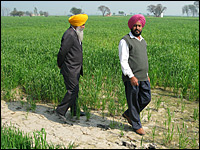
Great piece on NPR this morning about how the benefits of large-scale western-style agriculture in the Punjab region of India have quickly faded, bringing new problems in their wake.
When India's government launched the Green Revolution more than 40 years ago, it pressured farmers to grow only high-yield wheat, rice and cotton instead of their traditional mix of crops.
The new miracle seeds could produce far bigger yields than farmers had ever seen, but they came with a catch: The thirsty crops needed much more water than natural rainfall could provide, so farmers had to dig wells and irrigate with groundwater.
The system worked well for years, but government studies show that farmers have pumped so much groundwater to irrigate their crops that the water table is dropping dramatically, as much as 3 feet every year.
So farmers like Sandeep keep hiring the drilling company to come back to their fields, to bore the wells ever deeper — on this day, to more than 200 feet.
...
Studies show that their intensive farming methods, which government policies subsidize, are destroying the soil. The high-yield crops gobble up nutrients like nitrogen, phosphorous, iron and manganese, making the soil anemic.
The farmers say they must use three times as much fertilizer as they used to, to produce the same amount of crops — yet another drain on their finances.


 Posts
Posts


No comments:
Post a Comment